Trillium Lake, Oregon: The Mount Hood Reflection Guide
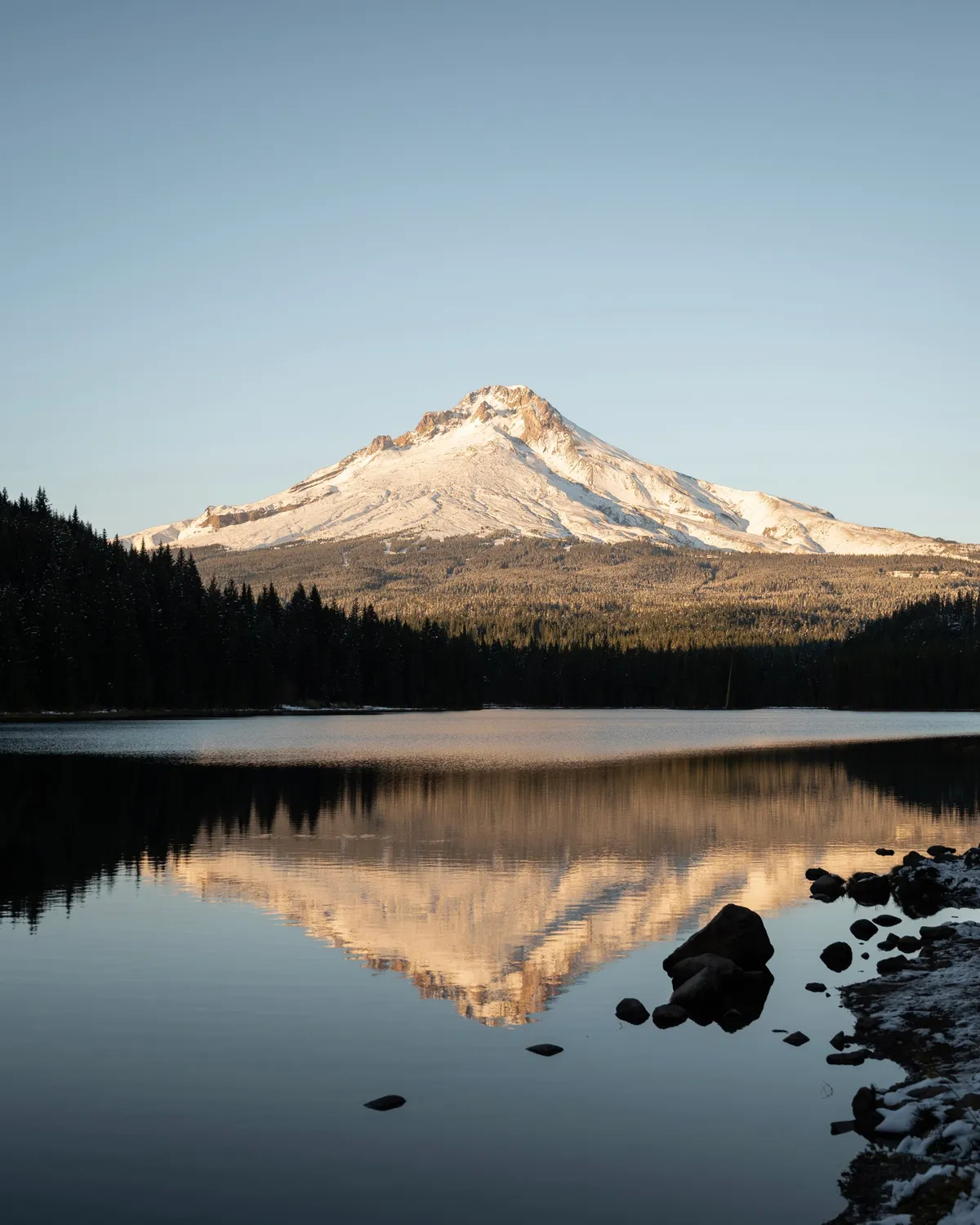
Trillium Lake is the Mount Hood reflection shot. If you’ve seen a photo of Hood mirrored in still water with a fringe of dark evergreens around it, there’s a good chance it was taken from the south end of this lake. It’s about an hour and fifteen from Portland, the walk to the best viewpoint is basically nothing, and on a calm morning it delivers exactly what it promises. I made my Mount Hood reflection print here. Here’s how to get in, when the road is actually open, and where to stand.
Where it is and how to get there
Trillium Lake sits at about 3,600 feet in the Mount Hood National Forest, just south of Government Camp. From Portland you’re looking at roughly 60 to 65 miles and somewhere between an hour fifteen and an hour thirty depending on traffic through Sandy.
The turnoff is Forest Road 2656, also called Trillium Lake Road, off US-26 about a mile east of Government Camp. Coming from Portland you pass Government Camp first and the turnoff is on your right. From the highway it’s a couple of miles in to the lake.
What it costs
Day use is $10 per vehicle, collected at a booth near the campground entrance. A Northwest Forest Pass covers it. An America the Beautiful pass does not, which catches people out. A lot of older posts still say the fee is $5, so budget for the current one.
When the road is open
This is the part worth actually planning around, because there are four separate seasonal windows and they don’t line up with each other.
For 2026, the day use area runs May 1 through December 1. The campground runs May 22 through October 31. The gate on Forest Road 2656 is closed from December 1 to April 1. And from November 1 through April 30 you need an Oregon Sno-Park permit to park at the trailhead lot.
The practical version: you can reliably drive to the lake from May through late November. April and late November are coin flips depending on snow. The lake actually opened around May 21 this year, and a run of storms in January 2026 closed a lot of roads in the forest, so a phone call is not a waste of time. The Zigzag Ranger District is 503-622-3191.
Getting there in winter
When the gate’s closed you can still get to the lake, you just ski or snowshoe in. You park at Trillium Sno-Park, a plowed 200-vehicle lot right at the FR 2656 junction, and follow the road down. The Forest Service puts it at 4.4 miles round trip. It’s flat enough that beginners do it comfortably, and with photo stops it’s about a three hour outing.
You need a Sno-Park permit, $4 for a day, $9 for three days, or $25 for the season. They aren’t sold at the lot, so buy one before you leave town.
Winter is also the quietest this lake ever gets. Midweek in the snow you can have the whole south shore to yourself, which almost never happens in July.
The lake itself
It’s small, around 63 acres, and shallow. Average depth is about 7 feet, deepest point around 21. It’s man-made, formed by a dam across Mud Creek, which feeds into the Salmon River.
The history is a little muddled. Wikipedia dates the dam to 1960 and credits ODFW. A Sandy Post piece describes Forest Service planners pushing for a lake after Timberline Lodge went up, specifically to have a scenic body of water reflecting the mountain, and rejecting the name Mud Lake for something better. Both accounts are out there and I haven’t seen them reconciled, so take your pick.
The loop trail around the lake is about 2 miles with almost no elevation change, maybe 45 minutes at a walk. Much of it was built barrier-free with boardwalk and compacted rock, and a new boardwalk section was finished in fall 2025. There’s an accessible fishing pier and boat launch, vault toilets, and a picnic shelter.
Boating is non-motorized only, so canoes, kayaks, and paddleboards. It gets stocked with rainbow trout. Swimming is allowed and there are no lifeguards. Dogs need to be leashed. The day use area has vault toilets but no drinking water, only the campground does, so bring your own.
Camping
The campground has 57 sites in the main loop plus sites 58 through 64 down near the dam. Single sites are $26 a night, doubles $50, an extra vehicle is $8, the yurt is $100, the group site $72, and the amphitheater site $90. No hookups, and 40 feet is the RV limit.
Reservations go through Recreation.gov, facility 232831, on the standard six month rolling window. Summer weekends here go in minutes. One reviewer put it as booking at 6am exactly six months out and still feeling lucky. If you want a weekend in July or August, set an alarm.
Shooting the reflection
Here’s the geometry that matters, and it explains most of the mistakes people make out here. Mount Hood sits at a bearing of about 17 degrees from the lake, so north-northeast, and it’s around 7.5 miles away. That means the sun never rises or sets behind the mountain. You are never going to get a backlit sun-behind-Hood shot here. The peak is side-lit or front-lit at both ends of the day, and the light is warm on the snow.
Shoot from the south end. The dam and the fishing pier are the spots, looking north across the water. The pier is under 50 yards from the trailhead, so this is not a hike, it’s a walk from the car.
Sunrise beats sunset, and the reason is wind rather than light. Mornings are calmer, and calm is the entire shot. By afternoon you’ve got thermals and boat traffic breaking up the surface, and once the water texture goes, the reflection goes with it. Get there at least an hour before sunrise. The alpenglow on Hood before the sun actually clears the horizon is often better than the sunrise itself.
For focal length, somewhere around 18 to 22mm is the sweet spot. Go wider than that and Hood shrinks into a small triangle at the top of your frame while you fill the rest with empty water.
Best months are early to mid May, when the peak is still fully snow-covered and the crowds haven’t arrived yet, and early November, when there’s fresh snow up top and the road is still open until December 1. November is the underrated one.
Crowds
On a busy summer day this place takes several hundred vehicles. The worst window is Friday through Sunday between 10am and 4pm, and parking gets close to impossible after about 11:30am even on a Friday. Sunrise on a weekday morning is a completely different lake.
There was an announcement in May 2026 about a shuttle running from the Sno-Park, but I haven’t seen confirmation that it’s actually operating, so don’t build a plan around it.
What’s actually growing there
The name suggests a trillium display and I can’t find anything backing that up at the lake itself. What you will see through the boardwalk sections and around the shallow edges is subalpine daisies in mid summer, marsh cinquefoil, yellow water-lilies out on the water, and skunk cabbage in the wet ground. The basin is mostly conifer, so don’t come out expecting fall color.
Nearby
Government Camp is about four miles away for food and coffee. Timberline Lodge is a short drive up the mountain, a 1937 WPA building and a National Historic Landmark, and it has the longest ski season in North America. Mirror Lake and Little Zigzag Falls are both close if you want a second stop.
Take the mountain home
The print I made here is the reason people come to this lake in the first place. Hood standing over the water with the whole thing doubled below it:
Mount Hood Reflection Photography Print →
It comes in sizes from a small 5x7 up to a 24x36 statement piece, printed on demand on matte or lustre paper, unframed with free shipping. It’s a calm, clean piece, and it works especially well for anyone with a connection to Oregon.
If you want more Mount Hood, I wrote about the Memaloose Hills out in the Columbia River Gorge, which gives you the same peak with a spring wildflower foreground. I’m a landscape and cityscape photographer based in Portland, and Hood is the mountain I keep going back to.