Kinrin Lake, Yufuin: Why It Steams and How to Shoot the Morning Mist
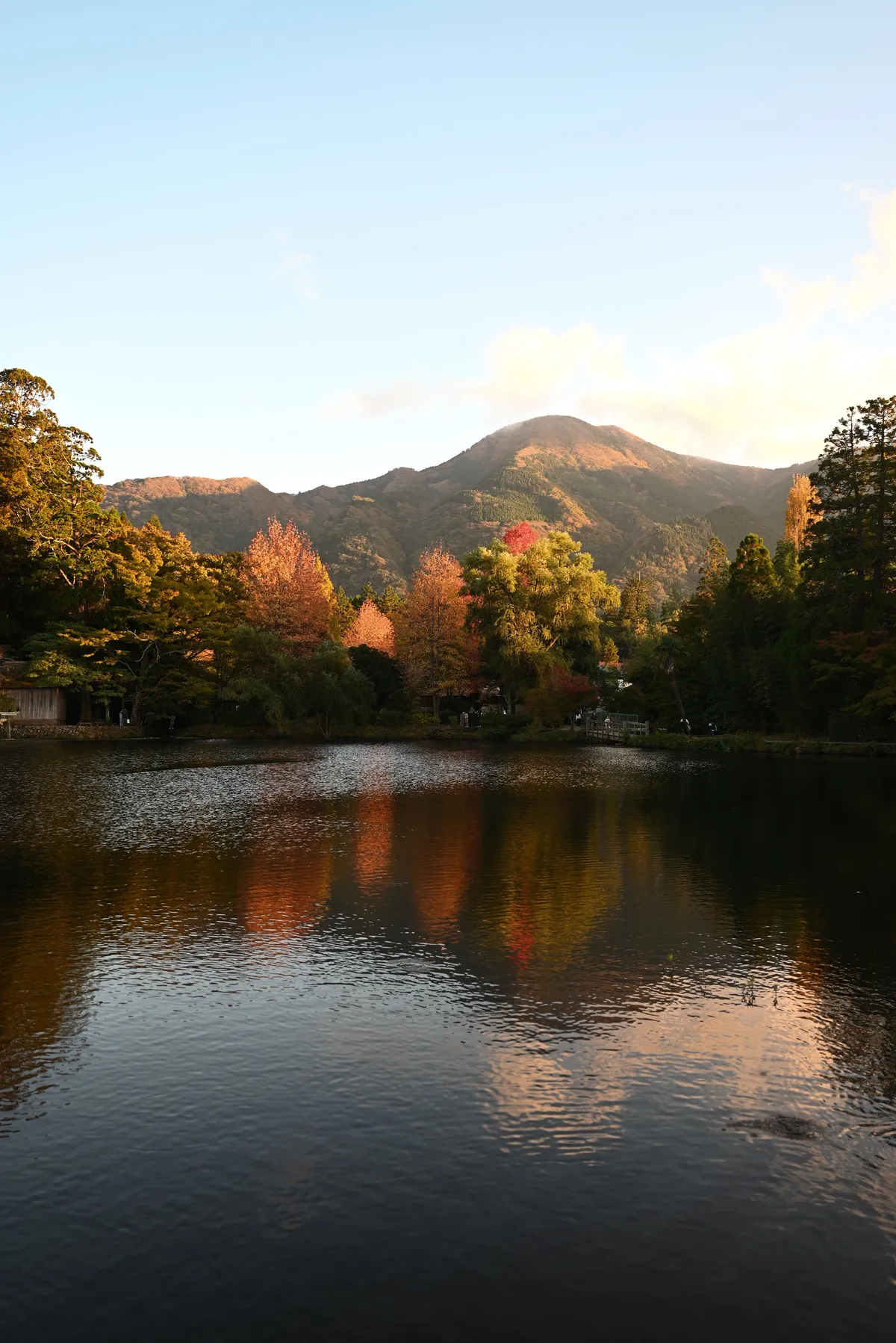
Kinrin Lake is a tiny lake at the edge of Yufuin, in Oita on Kyushu, and on the right morning it steams. Hot spring water wells up through the lake bed, the surface stays warmer than the air, and when the conditions line up the whole basin fills with mist while the sun comes up behind it. That’s the photo everyone is chasing out here, and it’s what I got my Lake Kinrin print from. Here’s why it steams, when it actually happens, and how to shoot it.
How small it really is
Worth saying up front, because photos make it look bigger. Kinrin Lake is 0.8 hectares. The full loop around it is about 400 meters, and it’s roughly two meters deep. You can walk the whole thing in 15 or 20 minutes. It’s one of the headwaters of the Oita River.
The size is part of why it works as a photo. Everything is close, the far bank is right there, and the mist doesn’t have far to travel to fill the frame.
Why it steams
Both hot spring water and cold spring water come up out of the lake bed at the same time. On top of that, five rivers feed into it and one of them carries hot spring water at around 30 degrees Celsius. The result is a body of water that stays warmer than the air around it year round, which is the whole mechanism behind the mist.
You’ll see a single temperature quoted for the lake in a lot of places, but the numbers floating around describe different things. The 30 degree figure is the thermal inflow, not the lake body, and at least one source puts the lake itself closer to 15. The useful version is simply that it’s warmer than the air, all year.
The name
It used to be called Takemoto-no-ike, the pond below the peak. In 1884 a Confucian scholar named Mori Kuso watched the setting sun catch the scales of the fish in the water and turn them gold, and renamed it Kinrinko, golden scale lake. That story is consistent across the Yufu City page, the local tourism association, and Japanese Wikipedia, which is more than you can say for most place-name legends.
It also tells you something practical. The lake was named for its evening light, not its morning mist.
When the mist actually happens
Season is autumn into winter. Some sources stretch it as wide as September through March, but the concentration is autumn and winter, and November is the month people plan around. Locals call the phenomenon kiribon, the mist basin.
Time of day is dawn through about 9am, and the densest mist is usually in the first 30 minutes after sunrise. It’s caused by radiative cooling overnight, so four things need to line up: a big temperature drop between the previous day and the early morning, weak wind, high humidity (rain the day before helps a lot), and clear skies overnight.
It is a probability, not a schedule. You can do everything right and get a flat, clear morning. If it matters to you, give yourself more than one morning.
The other thing about November is that the autumn foliage around the lake peaks early to mid month, right as the mist season gets reliable. That overlap makes November the single best window.
Shooting it
Shoot from the east side, facing the sunrise. That puts the light behind the mist, which is the difference between mist that reads as atmosphere and mist that reads as gray haze.
Get the camera low, close to the water. The lower you are, the more depth of mist you’re looking through, and the more it stacks up in the frame. Standing at eye level flattens it out.
Shoot into the sun for kobo, the visible light rays that come through when the mist is thick enough. That’s the shot.
The signature composition is the stone torii of Tenso Shrine standing in the water. It gives you a hard, dark shape to anchor a soft frame, and it’s the frame that reads as this specific lake rather than any misty pond.
There’s a second good window that most people skip. Dusk, when the low sun hits the water, which is literally the thing the lake was named for. Afternoons in between are the worst time to be here, both for light and for crowds.
Walking the loop
Tenso Shrine sits right on the shore with its torii in the water.
Shitanyu is the other landmark, a thatched-roof public bathhouse directly on the lake. It’s open 10am to 10pm with no closing days, it’s unstaffed, and you pay into an honesty box. Reported prices vary between 100 and a few hundred yen and it seems to have gone up recently, so bring coins. Inside there’s a small indoor bath with two tubs and a semi-open bath facing the lake, plus shelves for your clothes. No lockers.
Two honest warnings about Shitanyu. It’s genuinely mixed-gender bathing, not a translation quirk. And it’s partly visible from the public path around the lake. There’s multilingual signage prohibiting photography, which should go without saying, but it’s worth knowing what you’re walking past and what you’re walking into.
For coffee there’s Tenjo-sajiki, Cafe La Ruche attached to the Marc Chagall Kinrinko Museum, and Cafe Duo, which does 3D latte art for around 700 to 750 yen and is small enough that you want to be there when it opens.
Getting there
From Yufuin Station it’s about 1.5 kilometers, a 20 to 25 minute walk along Yunotsubo Kaido, closer to 30 if you stop at shops on the way. A taxi is about five minutes. The lake is free, open year round, and there’s no gate.
The catch for the morning mist is that you basically have to be staying in Yufuin. The mist is done by 9am and the earliest express train from Hakata doesn’t get in until 11:31. If you’re day-tripping from Fukuoka, this photo isn’t available to you.
What else is in town
Yufuin itself is worth a full day or a night, and the onsen town, Yunotsubo Street, Mount Yufu, and how to actually get there from Fukuoka or Beppu are all covered in my Yufuin guide.
One spot worth adding here specifically for photographers: the Narigori-dai observatory, about ten minutes by car up toward the pass, looks down on the whole basin. On a good morning you can see the mist filling the valley from above, which is the wide version of what you’re standing in at the lake.
Take the lake home
The print I made here is the quiet version of Kinrin, mist on the water and the shape of the shoreline coming through it:
It comes in sizes from a small 5x7 up to a 24x36 statement piece, printed on demand on matte or lustre paper, unframed with free shipping. It’s a soft, quiet piece, good for a bedroom or anywhere you want the room to slow down a little.
I’m a landscape and cityscape photographer based in Portland, and this lake is one of the quieter things I’ve photographed in Japan.